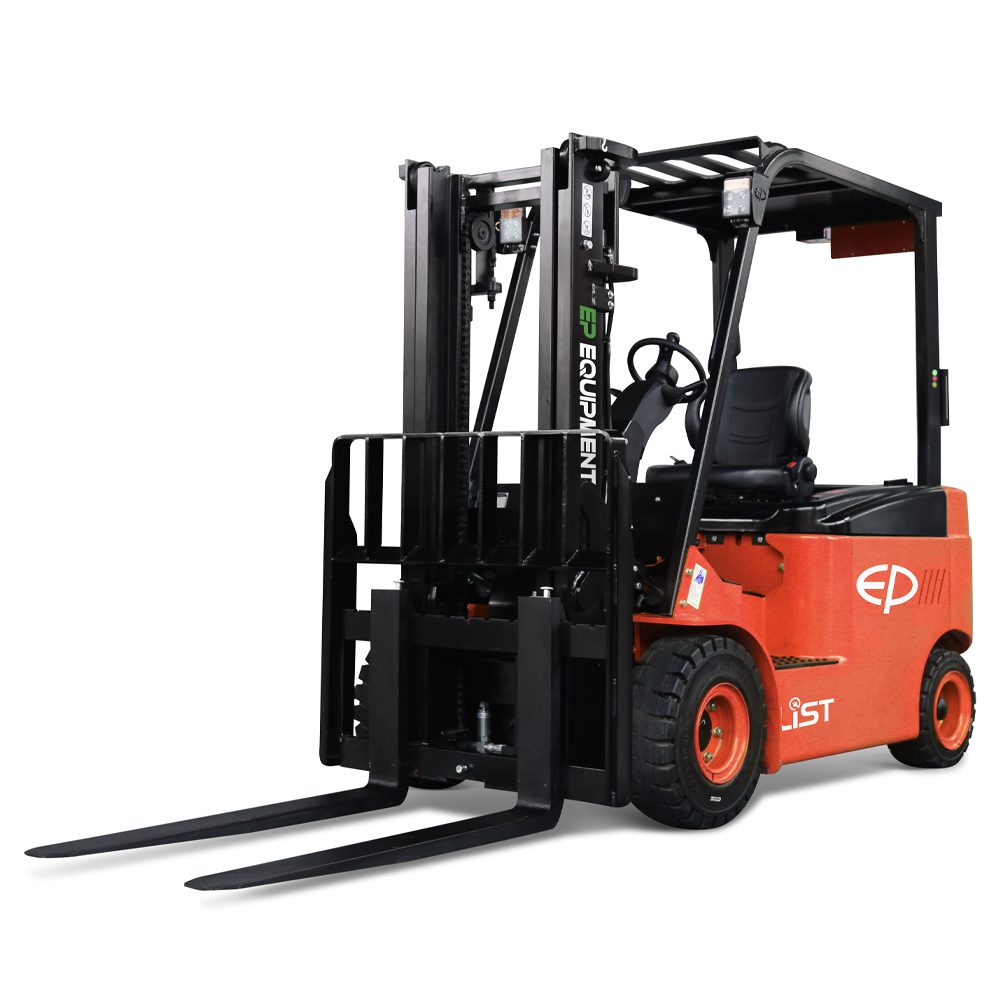
What is an electric counterbalance forklift?
A counterbalance forklift carries its load on forks out in front, with weight built into the rear of the truck to balance it. It is the most common forklift in the UK because it covers so much ground: unloading lorries, moving pallets across a yard, loading racking and feeding production lines.
An electric counterbalance forklift keeps that layout but replaces the engine, fuel tank and exhaust with a battery and electric motors. It drives and lifts much like a diesel truck, with no fuel to buy or store, no fumes and far less to service.
The L1(S) takes this further by being built for lithium-ion from the outset. On many older electric trucks a heavy lead-acid battery doubles as part of the counterweight. Here the battery is compact, so EP has used the space for a bigger cabin and better weight distribution.
CPD15/20/30/35L1(S) models and specifications
Four capacities share the same design. The 1.5 and 2.0 tonne trucks run on 48V with a narrower chassis, while the 3.0 and 3.5 tonne trucks move up to 80V for heavier loads and steeper ramps.
|
CPD15 |
CPD20 |
CPD30 |
CPD35 |
| Rated capacity |
1,500 kg |
2,000 kg |
3,000 kg |
3,500 kg |
| Load centre |
500 mm |
500 mm |
500 mm |
500 mm |
| Standard lift height |
3,000 mm |
3,000 mm |
3,000 mm |
3,000 mm |
| Battery |
48V/360Ah |
48V/360Ah |
80V/270Ah |
80V/270Ah |
| Overall width |
1,080 mm |
1,080 mm |
1,298 mm |
1,356 mm |
| Turning radius |
2,080 mm |
2,080 mm |
2,390 mm |
2,390 mm |
| Travel speed (laden/unladen) |
10.5/14 km/h |
10.5/14 km/h |
11/13 km/h |
11/13 km/h |
| Lift speed (laden/unladen) |
0.28/0.42 m/s |
0.28/0.42 m/s |
0.25/0.37 m/s |
0.25/0.37 m/s |
| Service weight |
2,640 kg |
2,950 kg |
4,530 kg |
4,675 kg |
Figures are from EP’s published data for the standard L1 truck with a 3 m mast. Duplex and triplex masts are available, including 4.8 m, 5.5 m and 6.0 m triplex options, and capacity reduces at height. We will confirm the exact specification for your truck, including any L1(S) differences, before you order.
Lithium-ion battery and charging
A full charge takes around 2.5 hours, and ten minutes on the charger adds roughly 7%. In practice, the truck can be topped up at breaks and shift changes instead of being parked for a long overnight charge.
There is no watering, no acid to handle and no need for a ventilated charging room. The battery management system protects the cells and passes their condition to the truck, so faults show on the display before they turn into downtime.
Lithium costs more to buy than lead-acid but less to run. On two or three shifts, the saving comes from having no spare batteries, no changeover equipment and less time lost to charging. We can work this out against your own hours before you commit.
Indoors, outdoors and in the wet
The L1(S) is IPX4 rated, so its electrics are protected against water splashing from any direction. With a four-wheel chassis for stability, it is built for yards and loading bays in British weather as well as warehouse floors.
Inside, there is no exhaust to worry about, so it can work close to food, finished goods and staff. The AC drive gives smooth acceleration and good pulling power on ramps, which helps on trips between the yard and the building.
Replacing a diesel or LPG counterbalance truck
If your site runs diesel or LPG counterbalance trucks up to 3.5 tonnes, the L1(S) is the obvious electric swap. The capacities match the most common IC trucks, the four-wheel chassis copes with similar ground, and operators get the cab space they are used to.
Before switching, we check where the truck will charge, how many hours it works and whether the site has steep or rough ground. For heavy, continuous outdoor duty on poor surfaces, the EFL253/303/353 may be the better fit. If narrow aisles are the main issue, look at an Aislemaster articulated forklift or a three-wheel truck from our electric forklift range.
Buy, hire or lease
The CPD15/20/30/35L1(S) is available to buy outright, on contract hire or lease, or on short-term hire. Short-term hire is a sensible first step if you are moving away from diesel and want to see how an electric counterbalance forklift handles your shifts before placing an order. See our hire and leasing options.
Every truck we supply is supported by our own engineers for planned maintenance, breakdowns and LOLER thorough examinations. See servicing and repairs. Adding forklift telematics gives you impact alerts, operator access control and real usage figures from the first day.