
Multi-directional and side loading forklifts for long loads and narrow aisles
Combilift Forklift Trucks
Long loads are awkward on a standard forklift. Carried across the forks, a six metre length of timber or steel needs an aisle wider than the load, a clear swing at every corner and a driver who can see past it. A Combilift changes the direction instead: the truck travels with the load running along its length, so it fits through any gap the truck itself fits through.
Forktruck Solutions supplies, hires and services electric Combilift forklift trucks across the UK. Our range covers the Combi-MR multi-directional forklift and the Combi-WR4 pedestrian reach stacker, both backed by the same servicing, hire and finance options as the rest of our fleet.
What is a Combilift?
Combilift is an Irish manufacturer, based in Monaghan, that has built specialist forklifts since 1998. The name has become shorthand for multi-directional and side loading forklifts in general, but it is a brand in its own right, and its trucks are designed around one problem: moving long, bulky or awkward loads through tight spaces.
The difference is in the steering. A standard forklift drives forwards and backwards. A Combilift truck can also turn its wheels and travel sideways, so with a length of pipe on the forks the operator switches direction and drives down the aisle with the load lying along the truck rather than across it.
That has a knock-on effect for the whole building. Aisles can be sized to the truck instead of the longest load, racking can go into space that used to be lost to turning, and long stock that sat outside in the yard can be stored indoors in cantilever racking.
The Combilift range
Two electric models: one ride-on, one pedestrian. Compare them below, or see the full details for the Combi-MR and the Combi-WR4.
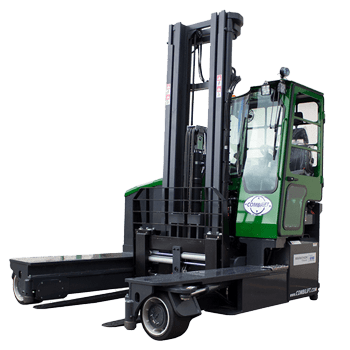
COMBI-MR MULTI DIRECTIONAL FORKLIFT
The COMBI-MR Multi-Directional Forklift showcases exceptional manoeuvrability, setting a new standard in material handling. Its compact design, paired with a single large rubber-tyred rear wheel, allows full-circle navigation across varied terrains.
This versatile machinery features a driver-friendly cabin, optimised for quick, efficient goods retrieval. Its multifunctional joystick offers smooth control over direction, speed and hydraulic operations, amplifying productivity in industrial distribution and logistics.
Proving itself a game-changer, the COMBI-MR brings agility, efficiency, and control to the forefront of forklift technology.
- Capacity: 2500 kg
- Platform Length: 790mm
- Overall Width: 1850 mm
- Engine Type Available: Electric
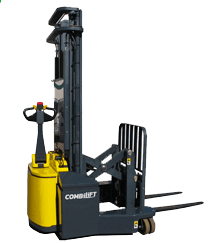
COMBI-WR4 PEDESTRIAN REACH STACKER
The COMBI-WR4 Pedestrian Reach Stacker exemplifies innovation in warehouse operations. Designed for ease of pedestrian operation, this nimble machinery traverses even the narrowest aisles with finesse, making efficient use of space. Its unique feature is the extendable reach arm, allowing high and deep stacking, optimising storage capabilities.
COMBI-WR4’s multi-functional controls provide operators with precise handling, combining directional movements, speed modulation, and hydraulic functions seamlessly.
Distinguished for its superb safety features, it ensures pedestrian operators navigate their workspace with confidence. The COMBI-WR4 Pedestrian Reach Stacker fundamentally revolutionises warehouse management, creating an agile, safe and productive environment.
- Capacity: 1450 kg
- Platform Length: 530 mm
- Overall Width: 1512 mm
- Engine Type Available: Electric
Which Combilift is right for you?
| Combi-MR | Combi-WR4 | Conventional side loader | |
|---|---|---|---|
| Operator | Seated, in cab | Pedestrian, walk-behind | Seated, in cab |
| Rated capacity | 2,500 kg | 1,450 kg | Usually 3,000 kg and above |
| Overall width | 1,850 mm | 1,512 mm | Wide chassis built for yard work |
| Direction of travel | Forwards, backwards, sideways and full-circle steering | Forwards, backwards and sideways | Forwards and backwards, load on a side deck |
| Working surface | Indoors and varied outdoor surfaces | Indoors on level floors | Mainly outdoor yards |
| Power | Electric | Electric | Often diesel or LPG |
| Handles pallets | Yes | Yes | Poorly |
| Best for | Long loads and pallets in narrow aisles, inside and out | Long loads in smaller stores where a ride-on truck is too big | High-volume long-load work in open yards |
Combi-MR and Combi-WR4 figures are taken from our product specifications. Capacity depends on mast height and load centre, so we will confirm the right configuration against your load lengths, weights and racking.
Side loading forklifts explained
A side loading forklift, often called a side loader forklift, carries its load on one side of the truck instead of in front. A traditional side loader has a fixed deck down one side and a mast that moves out to collect the load and draw it back onto the deck. The truck then drives forwards with the load alongside it.
That layout suits long, straight runs in an open yard, but it is a single-purpose machine. It is good with long loads, poor with pallets, and needs room to line up square to each bay.
A multi-directional Combilift forklift takes a different approach. The forks face forward like a normal truck, so pallets are picked up the usual way. When the load is long, the wheels turn through 90 degrees and the truck travels sideways. The result is one machine doing work that would otherwise need a side loader and a standard forklift.
For sites handling timber, steel, pipe, uPVC profile, sheet materials, doors or windows, that is usually the deciding factor.
Combilift vs reach truck and counterbalance forklift
Each of these machines is built for a different type of load and a different layout, so it helps to be clear on where each one fits.
Counterbalance forklift. Carries the load out in front and works indoors and out, including yards and loading bays. With a long load across the forks, it needs an aisle wider than the load and plenty of room at every corner. See our electric forklift trucks.
Reach truck. Made for standard pallets in narrow aisles and high racking, on level indoor floors. For pallet storage at height it is the better tool, but it cannot carry a long load lengthways. See our electric reach trucks.
Combilift. Handles pallets and long loads with the same truck, travels sideways along narrow aisles and, in the case of the Combi-MR, moves between the warehouse and the yard. If your stock is mainly pallets in very narrow aisles, an articulated truck is also worth comparing. See Aislemaster articulated forklifts.
Plenty of sites run a mix: a Combilift for long and awkward stock, reach or articulated trucks in the pallet racking, and pallet trucks for ground-level moves at the dock.
Where Combilift trucks are used
- Timber and builders merchants – timber lengths, sheet materials and mouldings moved between the yard and covered racking.
- Steel stockholders and engineering – bar, tube, section and sheet held in cantilever racking and fed to saws and machining centres.
- Plastics and uPVC – extrusions, profile and pipe in long, light bundles that bow when lifted across the forks.
- Window, door and kitchen manufacturers – frames, worktops and panels moved through busy production areas.
- Furniture and flooring – carpet rolls, flooring packs and bulky stock in stores with little room to turn.
- General warehousing – mixed pallets and long goods in one building, without a separate truck for each.
The Combi-WR4 fits the smaller end of this list: trade counters, workshops and stores where a ride-on truck would be too big but the loads are too long for a pallet truck.
Electric power and running costs
Both Combilift trucks in our range are electric. That suits a machine that spends most of its day indoors.
No exhaust. There are no fumes to manage, so the truck can work in enclosed stores, near production staff and around finished goods without extra ventilation.
Lower running costs. Electricity costs less per working hour than diesel or LPG, and an electric drive has far fewer parts to wear. There is no engine oil, fuel system or exhaust to maintain.
Quieter shifts. Electric trucks are much quieter, which helps where people work close to the machines or where early and late shifts run near housing.
The right battery. Battery type and capacity are matched to how you work. We look at hours of use, charging opportunities and site layout first, so the truck gets through the shift without paying for capacity you will not use.
Combilift training, safety and thorough examination
A Combilift is lifting equipment, so it comes under LOLER as well as PUWER. Running one safely comes down to three areas.
Operator training. Multi-directional and side loading trucks behave differently from a standard forklift, particularly when travelling sideways with a long load. Operators need accredited training for the type of truck they will drive, and pedestrian machines such as the Combi-WR4 need their own training as well.
Thorough examination. Under LOLER the truck needs a thorough examination at least every 12 months, sooner if it works hard. A competent person carries it out and records it separately from servicing.
Daily checks and load security. Pre-use checks should cover forks, mast, chains, hydraulics, tyres and steering. With long loads, make sure bundles are banded and evenly balanced before lifting, because an unstable load is often a bigger risk than the truck.
Statutory inspection can go on the same contract as planned maintenance. See servicing and repairs.
Hire, finance and servicing for your Combilift
You do not have to buy a Combilift outright. We offer sale, contract hire, lease and short-term hire, so the cost can sit wherever it suits your budget. Short-term hire is also a practical way to try a multi-directional truck on your own site before you commit. See our hire and leasing options.
Servicing comes from our own engineers, covering planned maintenance, breakdowns, parts and thorough examinations. Alongside the usual forklift checks, they look after the steering system that lets a Combilift travel sideways. We work on all makes, so it can sit on one contract with your other trucks.
On larger fleets, forklift telematics adds impact alerts, operator access control and utilisation reports, so you can see whether each truck is earning its keep.
GET IN TOUCH
Every site is different. Tell us what you are moving, how long the loads are and how much room you have, and we will recommend the right Combilift for the job.
T: 01924 265623
Combilift FAQs
What is a Combilift?
Combilift is an Irish manufacturer of multi-directional and side loading forklifts, founded in 1998. Its trucks can travel sideways as well as forwards and backwards, so long loads such as timber, steel and pipe can be carried along the length of the truck through narrow aisles. The name is also widely used for this type of forklift in general.
What is a side loading forklift?
A side loading forklift, or side loader, carries its load along one side of the truck rather than in front of it. This keeps long loads in line with the direction of travel, so the truck needs far less room to move them. Traditional side loaders are mostly used outdoors in timber and steel yards, while multi-directional trucks such as the Combi-MR do the same job and also handle pallets.
What is the difference between a side loader and a Combilift forklift?
A traditional side loader has a fixed deck on one side and only drives forwards and backwards. A multi-directional Combilift has forward-facing forks and wheels that turn, so it can travel sideways too. It can handle pallets like a standard forklift and long loads like a side loader, which often means one truck instead of two.
What loads can a Combilift handle?
Combilift trucks are built for long and awkward loads such as timber, steel bar and tube, pipe, uPVC profile, sheet materials, doors and worktops, and they handle standard pallets as well. In our range, the Combi-MR is rated to 2,500 kg and the Combi-WR4 to 1,450 kg.
What aisle width does a Combilift need?
Because a Combilift carries long loads lengthways, the aisle is sized to the truck and the depth of the load rather than the length of the load. That usually allows much narrower aisles than a counterbalance forklift handling the same stock. The exact figure depends on the model, the load and the racking, so we will work it out against your site layout.
What is the difference between the Combi-MR and Combi-WR4?
The Combi-MR is a ride-on multi-directional forklift with a cab, rated to 2,500 kg and able to work indoors and out. The Combi-WR4 is a pedestrian reach stacker rated to 1,450 kg, with a narrower 1,512 mm overall width for smaller stores with level floors. The MR suits heavier, busier operations, and the WR4 suits lighter work where a ride-on truck is more than you need.
Can a Combilift be used outside?
The Combi-MR has a large rubber-tyred drive wheel and full-circle steering, so it can move between the warehouse and outdoor surfaces. The Combi-WR4 is designed for indoor use on level floors. Tell us about your ground conditions and we will confirm which truck suits your site.
Do you need a licence to drive a Combilift?
There is no single legal forklift licence in the UK, but operators must be trained and authorised by their employer. For a Combilift, that means accredited training on multi-directional or side loading trucks, as a standard counterbalance certificate does not cover them. Pedestrian trucks such as the Combi-WR4 need their own training too.
Do Combilift trucks need a thorough examination under LOLER?
Yes. As lifting equipment, a Combilift must be thoroughly examined by a competent person at least every 12 months, or more often if it works hard. This is separate from routine servicing, and we can carry out thorough examinations alongside planned maintenance.
Can I hire a Combilift rather than buy one?
Yes. As well as outright sale, we offer short-term hire, contract hire and leasing. Short-term hire works well for seasonal peaks, one-off projects or trying a multi-directional truck on site before buying.
Who services Combilift forklifts?
Forktruck Solutions services Combilift trucks through our own directly employed engineers across the UK, covering planned maintenance, breakdowns, parts and LOLER thorough examinations. We work on all makes, so your Combilift can share a contract with the rest of your fleet.