
Narrow-aisle lithium-ion reach trucks for high-bay warehouse storage
Electric Reach Trucks
A reach truck is the machine that lets a warehouse build upwards instead of outwards. Where a counterbalance forklift needs a wide aisle to turn and stack, a reach truck works in aisles under three metres and places pallets at heights a counterbalance cannot safely reach – so the same floor area holds considerably more stock.
Forktruck Solutions supplies, hires and services lithium-ion electric reach trucks across the UK, built around the EP CQD16L and CQD20L. Both run on maintenance-free 48V/405Ah lithium-ion batteries that take a 7% charge in ten minutes, so a machine tops up during a tea break rather than sitting on a charger between shifts.
What is a reach truck?
A reach truck is an electric warehouse forklift designed for narrow aisles and high racking. Its forks sit on a carriage that travels forward and back along the mast, so the truck itself can stay within the aisle while the load moves out over the racking beam. That single design difference is what allows aisles to be cut to roughly 2.7–3.2 metres instead of the 3.5–4.5 metres a counterbalance machine needs.
You will also see the same machine called a high reach forklift, a reach forklift truck or reach fork lift trucks – they all describe the same thing. Operators stand or sit sideways-on, which gives clear sight of the forks at height and makes repeated pallet placement far less tiring across a shift.
Reach trucks are almost always electric and almost always used indoors on a level surface. They are a storage machine rather than a yard machine: the trade-off for the lift height and the narrow aisle is that they are not built for rough ground, gradients or heavy outdoor use.
The EP reach truck range
Two lithium-ion models covering most warehouse duties. Compare the CQD16 and CQD20 below, then talk to us about mast height, cab options and battery specification for your racking.
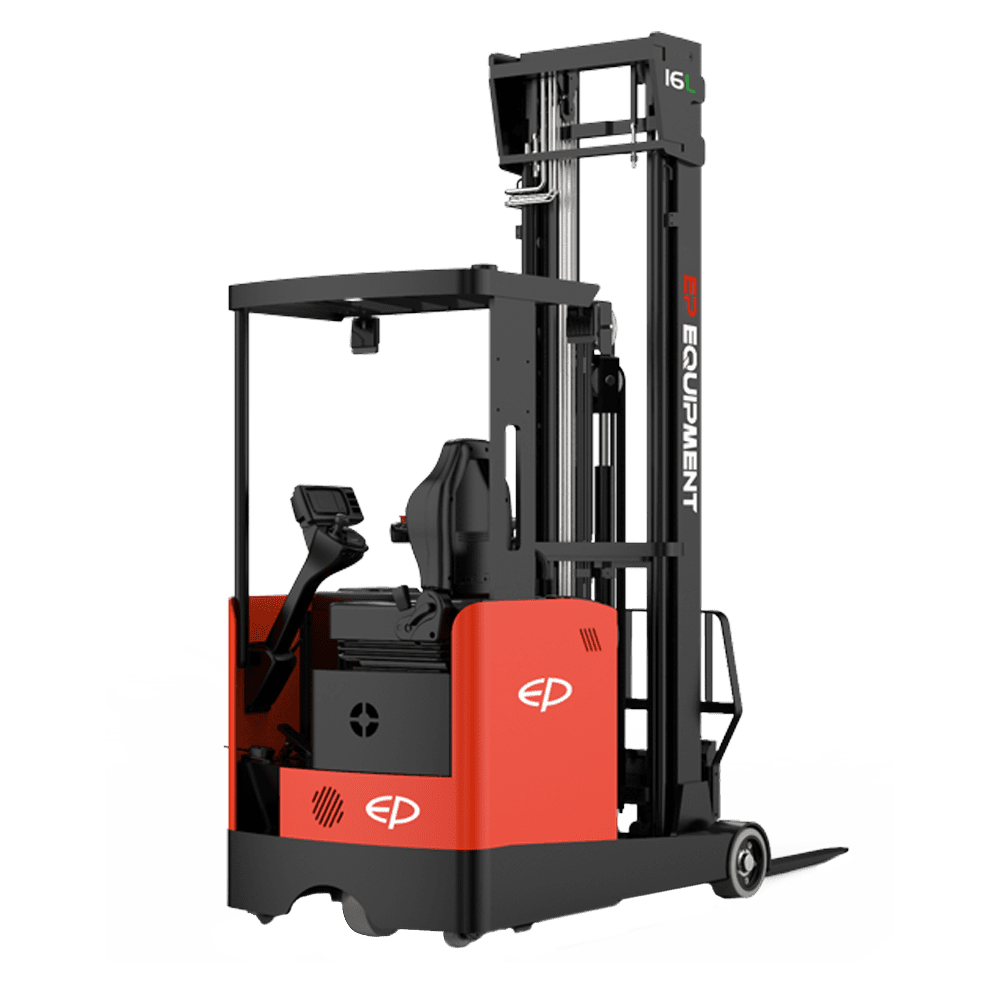
CQD20
Revolutionary 48V/405Ah Li-Ion Batteries: Unleash 7% Charge in Just 10 Minutes, Elevating Productivity During Short Breaks. Can-Bus Communication Maximizes Truck Efficiency.
CQD16L/20L epitomizes EP’s Li-Ion technology prowess. Crafted with unwavering engineering tradition and EP’s extensive expertise, this series delivers precision in stacking, quiet operation, and unmatched stability. Its compact design and upgraded features enhance operational visibility and bolster workplace safety. Whether you’re navigating tight spaces or handling heavy loads, the CQD16L/20L is the ideal choice for a seamless and efficient material handling experience.
Features
- Optimal Visibility
- High Stability
- Enjoyable Lifting Operation
- Easy and Precise Operation
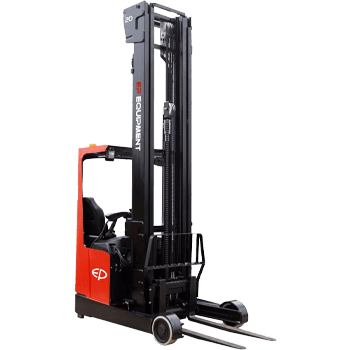
CQD16
Maintenance-free 48V/405Ah Li-Ion batteries, supporting swift 7% charging in 10 minutes for productivity-boosting short breaks. Can-Bus communication optimises truck usage efficiently.
CQD16L/20L epitomizes EP’s Li-Ion technology prowess. Crafted with unwavering engineering tradition and EP’s extensive expertise, this series delivers precision in stacking, quiet operation, and unmatched stability. Its compact design and upgraded features enhance operational visibility and bolster workplace safety. Whether you’re navigating tight spaces or handling heavy loads, the CQD16L/20L is the ideal choice for a seamless and efficient material handling experience.
Features
- Optimal Visibility
- High Stability
- Enjoyable Lifting Operation
- Easy and Precise Operation
Which reach truck is right for you?
| EP CQD16 | EP CQD20 | |
|---|---|---|
| Rated capacity | 1,600 kg | 2,000 kg |
| Load centre | 600 mm | 600 mm |
| Lift height | 6.5 m standard mast | 7.5 m standard mast |
| Overall width | 1,090 mm | 1,270 mm |
| Travel speed | Approx. 9 km/h | Approx. 9 km/h |
| Service weight | Approx. 2.9 t | Approx. 3.5 t |
| Battery | 48V lithium-ion | 48V lithium-ion |
| Best for | Lighter pallets, tightest aisles | Heavier pallets, taller racking |
Figures are for the standard mast and battery. Taller masts and alternative cab and fork specifications are available – we will confirm the exact configuration against your racking height and pallet weights.
Reach truck vs counterbalance forklift
The two machines solve different problems, and picking the wrong one is expensive in floor space or in machines.
A counterbalance forklift carries the load out in front on a fixed mast, balanced by weight at the rear. It drives straight up to a pallet, works indoors and out, and handles yards, loading bays and uneven ground. The cost is aisle width – it needs roughly 3.5 to 4.5 metres to turn and stack.
A reach truck keeps the wheels inside the aisle and pushes the forks forward into the racking instead. It works in aisles of around 2.7 to 3.2 metres and lifts considerably higher, but it is an indoor machine on level floors.
Most warehouses end up running both: counterbalance machines on the yard and loading bay, reach trucks inside the racking. If your aisles are narrower still, an articulated machine that does both jobs is worth looking at. See our forklift trucks or compare Aislemaster articulated forklifts.
Where reach trucks are used
- Distribution and 3PL warehouses – high-bay pallet racking where storage density decides the cost per pallet position.
- Manufacturing stores – raw material and finished goods racking alongside production, where noise and fumes matter.
- Cold storage – narrow aisles in chilled and frozen areas, where every cubic metre is expensive to run.
- Retail and e-commerce fulfilment – replenishing pick faces from bulk racking above.
- Food and pharmaceutical – clean, zero-emission operation in temperature and hygiene controlled areas.
- Builders merchants and wholesale – indoor racking for heavy, awkward stock that a pallet truck cannot lift.
Reach trucks sit naturally alongside pallet trucks for ground-level movement and order pickers for case picking. Most sites run all three.
Lithium-ion batteries, charging and running costs
Both EP reach trucks run 48V/405Ah lithium-ion batteries, and on a multi-shift site that is where the operating case is won.
No battery changing. A lead-acid machine on two or three shifts needs spare batteries, a changing station, the floor space for both and the labour to swap them. Lithium removes all of it – the truck charges in the aisle it works in.
Opportunity charging. A 7% top-up in ten minutes means breaks and handover gaps do the work that a full charge cycle used to. There is no memory effect and no damage from partial charging.
No watering, no gassing. The batteries are maintenance-free and sealed, so there is no topping up, no acid handling and no dedicated ventilated charging room – which also makes them straightforward in food and pharmaceutical areas.
Energy and life. Lithium takes more charge into useful work than lead-acid and holds voltage to the end of the cycle, so lift speeds do not fall away late in a shift. Over a typical replacement cycle the higher purchase price is usually recovered in labour, floor space and energy. We will model it against your shift pattern before you commit.
Reach truck training, safety and thorough examination
A reach truck is lifting equipment, so it falls under LOLER as well as PUWER. In practice that means three things for any site running them.
Operator training. Operators need accredited training specific to reach trucks – a counterbalance ticket does not cover them. The sight lines, the reach action and working at height all behave differently, and refresher training is expected on a defined cycle.
Thorough examination. Lifting equipment used at work must be thoroughly examined at least every 12 months, and more often where the duty is heavy. This is separate from routine servicing and produces its own report.
Daily checks and racking. Pre-use checks should cover forks, mast, chains, hydraulics, tyres and the reach carriage. It is also worth having racking inspected on the same cycle – most damage a reach truck causes shows up in the racking first.
We can cover statutory inspection alongside planned maintenance on one contract. See servicing and repairs.
Hire, finance and servicing for your reach truck
A reach truck does not have to be a capital purchase. Forktruck Solutions offers outright sale, contract hire, lease and short-term hire, so the machine can sit on whichever budget line suits you – and short-term hire is the straightforward way to cover a peak season or trial a lithium machine on your own racking before committing. See our hire and leasing options.
Every machine is supported by our own directly employed engineers. Planned maintenance, breakdown cover, parts, battery support and thorough examination are handled in-house rather than subcontracted, and reach trucks can go on the same contract as the rest of your fleet.
If you run more than a handful of machines, telematics is worth having from the start – impact monitoring, operator access control and utilisation data usually pay for themselves in damage alone. Find out about fleet telematics.
GET IN TOUCH
Every warehouse is different. Tell us your racking height, aisle width and pallet weights and we will specify the right reach truck for the job.
T: 01924 265623
Reach truck FAQs
What is a reach truck used for?
A reach truck is used to store and retrieve palletised goods in narrow-aisle, high-bay racking inside a warehouse. The forks extend forward from the mast so the truck stays in the aisle while the load moves out over the racking beam, which allows aisles of roughly 2.7 to 3.2 metres and lift heights well beyond what a counterbalance forklift can safely manage. Typical work includes putting away incoming pallets, replenishing pick faces from bulk storage above, and retrieving full pallets for despatch.
What is the difference between a reach truck and a counterbalance forklift?
A counterbalance forklift carries the load out in front on a fixed mast, offset by weight at the rear. It works indoors and outdoors, handles yards and loading bays, and needs roughly 3.5 to 4.5 metres of aisle to turn and stack. A reach truck keeps its wheels inside the aisle and pushes the forks forward into the racking, so it works in aisles of around 2.7 to 3.2 metres and lifts considerably higher, but it is an indoor machine for level floors. Most warehouses run both.
How high can a reach truck lift?
It depends on the mast. The EP CQD16 lifts to 6.5 metres and the CQD20 to 7.5 metres on the standard mast, and taller masts are available to order. The right answer is set by your top beam height rather than the machine, so we measure the racking and confirm the mast against it, allowing for headroom, sprinklers and the residual capacity at full height.
What aisle width does a reach truck need?
Most reach truck applications work in aisles of about 2.7 to 3.2 metres, against 3.5 to 4.5 metres for a counterbalance forklift. The exact figure depends on the machine, the pallet size and how it is presented. If your aisles are narrower than that, an articulated or very narrow aisle machine is the better fit and we can quote both.
Do you need a licence to drive a reach truck?
There is no road licence for a reach truck, but operators must hold accredited training specific to reach trucks before using one at work. A counterbalance forklift ticket does not cover a reach truck: the sight lines, the reach action and working at height all behave differently. Employers are also responsible for site-specific familiarisation and refresher training on a defined cycle.
What is the difference between the EP CQD16 and CQD20?
The CQD16 is rated at 1,600 kg with a 6.5 metre standard mast and an overall width of 1,090 mm, which suits lighter pallets and the tightest aisles. The CQD20 is rated at 2,000 kg with a 7.5 metre standard mast and an overall width of 1,270 mm, for heavier pallets and taller racking. Both run the same 48V lithium-ion battery system.
How long does a lithium-ion reach truck battery take to charge?
The 48V/405Ah lithium-ion batteries take a 7% charge in about ten minutes, so short breaks and shift handovers keep the machine topped up through the day. A full charge is typically done overnight. Because lithium has no memory effect, opportunity charging during breaks does not shorten battery life the way it would on lead-acid.
Can a reach truck be used outside?
Not as a rule. Reach trucks have small wheels, low ground clearance and cushion tyres designed for smooth, level warehouse floors, and most are not rated for weather exposure. Brief use on level, sealed hardstanding under cover is sometimes acceptable, but yard work, gradients and uneven ground call for a counterbalance forklift instead.
Do reach trucks need a thorough examination under LOLER?
Yes. A reach truck is lifting equipment, so it must be thoroughly examined at least every 12 months, and more frequently where the duty cycle is heavy or the machine lifts people. That is a separate statutory requirement from routine servicing and produces its own report. Forktruck Solutions can carry out thorough examination alongside planned maintenance on one contract.
Can I hire a reach truck rather than buy one?
Yes. Forktruck Solutions offers short-term hire, long-term hire, contract hire and lease alongside outright purchase, and all of them can include servicing and breakdown cover. Short-term hire is the usual way to cover a peak season, bridge a gap while a machine is repaired, or trial a lithium-ion reach truck on your own racking before making a fleet decision.
Who services reach trucks?
Forktruck Solutions services reach trucks with its own directly employed engineers, covering planned maintenance, breakdown repairs, parts, battery support and LOLER thorough examination. Reach trucks can be placed on the same service contract as your counterbalance, pallet truck and order picker fleet, so the whole site sits under one agreement and one point of contact.